Showing posts with label Mopar. Show all posts

Friday, January 5, 2024

Hard to Kill: 1971 Dodge Charger

There are some old cars that were built in quantity that you never see on the road. Sometimes that's because they weren't very durable. The Jaguar XKE comes to mind. Then there are cars like the third and last generation of the original Dodge Charger. You never see them because every guy who owned one drove it like Mad Max.


Tuesday, June 28, 2022

1969 Dodge Charger Daytona

After a two-year absence, the Greenwood Car Show is back and the weather was perfect last Saturday. This car was probably the biggest "wow" moment for me. So if you've got at least $250K to spare, you should be able to pick up one of the few '69 Charger Daytonas still in circulation. That year, Nascar required that 500 copies of a "stock" car be made for it to qualify for the track, so Dodge dropped either the 426 hemi or 440 V-8 engine into 502 copies of the Charger, then added a fiberglass nose and outrageous rear spoiler. I've heard the reason why the spoiler was so high was that it was set at the height needed to allow the trunk to be opened. In 1970, Nascar increased the minimum production for a stock car to qualify for the track from 500 copies to 2,000, so Chrysler built 1,920 Plymouth Road Runner Superbirds very similar to this car. The following year Nascar dropped the whole "stock cars have to be actual stock cars" requirement.


Monday, May 24, 2021

1967 Imperial LeBaron by Chrysler

You're looking at the most expensive American car you could buy in 1967. Chrysler's flagship Imperial listed at $6,661 in 1967. That $53K today; a heckuva lot less that you can pay for a car in 2021. Note this is a 4-door hardtop. Power down all the windows for a very breezy experience.


Wednesday, May 19, 2021

1970 Plymouth Barracuda 'Cuda 340 convertible

Only 8,939 Dodge Challenger and Plymouth Barracuda convertibles were made in 1970-71, and despite being relatively inexpensive cars when new, they command staggering prices today, particularly when fitted out with the rarer performance options. This is one of only 435 'Cuda convertibles built in 1970, and I'd say it's worth at least $80,000. Here's an even more valuable 'Cuda convertible I spotted in 2019.


Thursday, February 25, 2021

1969 Dodge Coronet 440

I doubt that whoever bought this car new thought of it as a future classic, but pretty much anything built by Chrysler between 1965 and 1970 is now a collectable. The model number '440' does not mean that this car was sold with Chrysler's biggest engine - there was also a 'Coronet 500'. Most of these were sold with the 318 V8 and it could be bought with the 383.


Tuesday, January 26, 2021

Why Aren't You Terrorizing a High School Somewhere? 1973 Plymouth Duster

Like the Chevy Nova from the same era, the Duster was a favorite for swapping in a big, smoky V8 and loudly announcing one's obnoxious presence to one's public school classmates.

Here's an unmodified Duster from the same year.


Tuesday, May 19, 2020

1964 Imperial Crown

Nearly 20 feet long and weighing two and a half tons, brand new this Imperial by Chrysler would have run you nearly $50,000 in inflation-adjusted dollars. 430 horsepower, push-button everything.

Observations:
* This car doesn't appear to have moved in years. It is probably destined to become a parts car for the restoration of a convertible or coupe. There aren't that many junker Imperials in circulation.
* The number of Imperials still around was reduced that much further by the employment of twenty-nine cars from this era to make the Green Hornet movie in 2010.


Tuesday, March 17, 2020

1941 Dodge WC Pickup Truck - Mad Max!


If this truck reminds you of the truck from Mad Max - Fury Road, that's because it is the same truck. Time and the elements can do wonders for giving a vehicle that post-apocalypse movie look.


Friday, March 13, 2020

1966 Dodge Charger

This rare beast is nearly identical to the '66 Charger I owned in the mid-90s. Mine was gold, but it also had the Magnum rims and Torqueflight automatic transmission.


Thursday, November 21, 2019

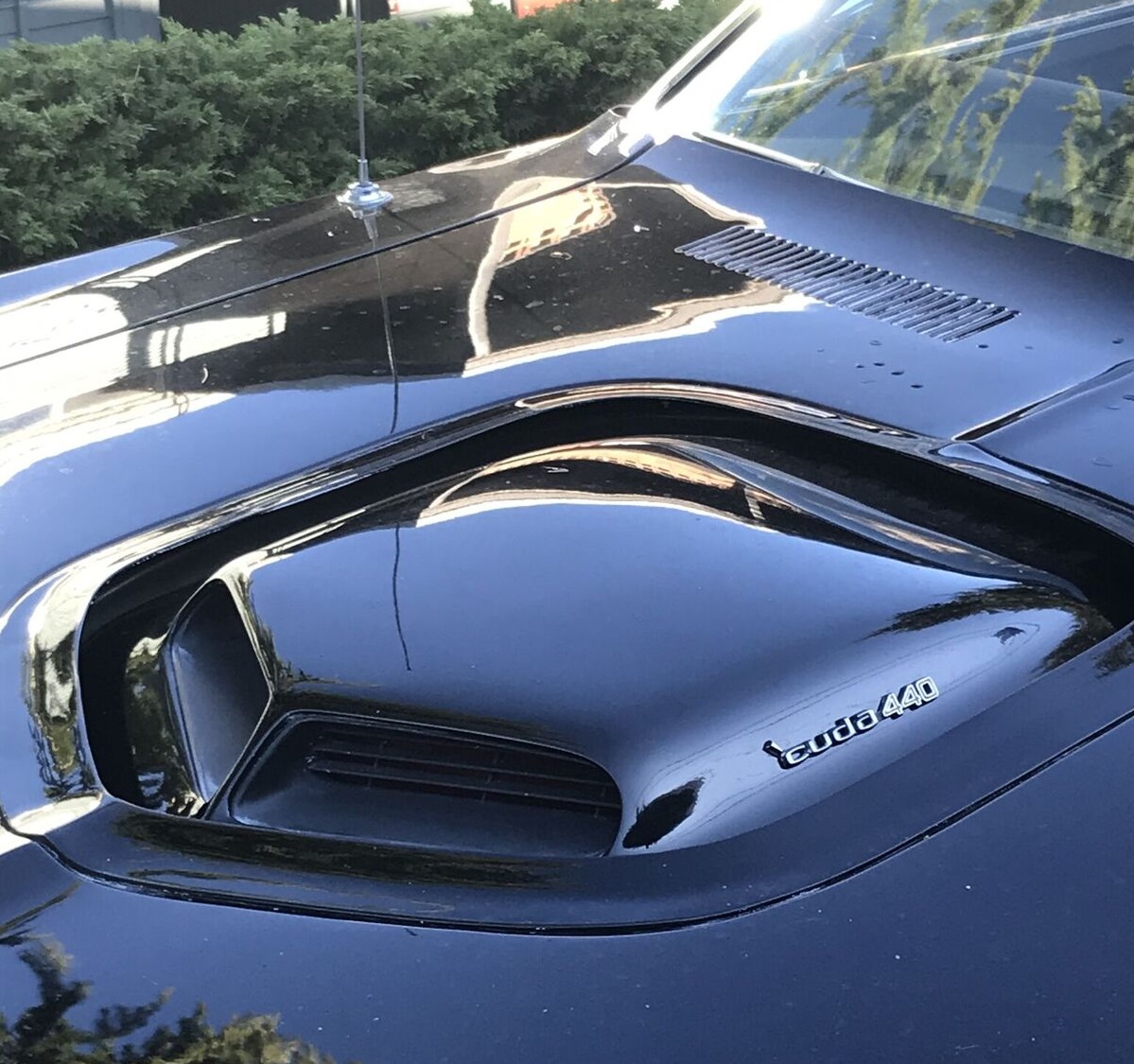
1970 Plymouth Barracuda 'cuda 440 convertible

WOW this is without a doubt the most amazing car I've spotted in use as a daily driver in Seattle. Only 8,939 Dodge Challenger and Plymouth Barracuda convertibles were ever made, and only 435 'cuda convertibles were built in 1970. Assuming this car has its original engine, it's worth upwards of $100,000.


Saturday, May 11, 2019

1978 Plymouth Volaré

Volare, oh oh! Cantare, oh oh oh oh! - Dean Martin

I've been looking for a still-running Volaré since I started this blog. And on this surprisingly summer-like day in May, jackpot!

In the 1970s, Detroit seemed to stagger from disaster to another, and the biggest for deeply-troubled Chrysler was the long-awaited replacement for its highly-popular and durable A-body models, which included the Dodge Dart and Plymouth Valiant and Duster.

From curbsideclassic.com
"Chrysler must have known that replacing the A-team successfully would be a mission-critical task. Boy, did they ever flub it. Their compacts went from being the most durable to the most-recalled in history, up to that time; GM’s X-bodies soon stole that title. It was 1957 all over again, but worse. At least Chrysler had the foresight to call them “F-Bodies”. From an A to an F, without any intermediate stops; what a fail.

Beta-testing new cars on a mass scale is just not a good idea. Build quality was all-round crappy, at best. It went downhill from there: five mandatory recalls covering a variety of ills with suspension, ignition, fuel system, brakes, steering and body. The one that had the highest visibility (literally) was pre-mature rusting of the front fenders. All (Plymouth Volarés and Dodge Aspens) had fenders inspected, removed, replaced and/or galvanized, and repainted to the tune of $109 million. That was serious bucks to Chrysler then, especially since the whole mothership was rusting away.

Lee Iacocca had this to say: “The Dart and Valiant ran forever, and they should never have been dropped. Instead they were replaced by cars that often started to come apart after only a year or two. When these cars first came out, they were still in the development phase. Looking back over the past twenty years or so, I can’t think of any cars that caused more disappointment among customers than the Aspen and the Volaré”. Honest, but easy for him to say, since he wasn’t responsible."


Thursday, March 21, 2019

1969 Dodge Charger

This Charger is in pretty good shape for an unrestored car. Even the vinyl top has held up, for the most part.
* I like the dog dish hub caps.
* Those are vintage Washington state license plates.


Tuesday, January 22, 2019

1970 Dodge Dart Custom

Very similar to the '70 Plymouth Duster we spotted, this Dart is an example of the forgotten phenomenon of American automakers offering incredibly powerful engines in what were otherwise their smallest, cheapest cars.

While the 340 c.i. V-8 was available for the Dart, it certainly did not come with the dual-quad carburetor fuel intake system the current owner has installed. Pretty neat though.


Friday, December 21, 2018

1978 Plymouth Fury A38-Pursuit

Let me tell you about the greatest police car ever made. In 1980s, when police would try to pull over a speeder, if the leadfoot driver was in a old GTO or some other fast car from a bygone era, he would just drive away, knowing that the cop couldn't catch him. That's because police cars had gotten a lot slower. The Dodge St. Regis (what kind of name is that?) police car of 1980 probably only had a 318 V-8 to pull all that weight around, thanks to big engines going out of fashion. Not to mention the fact that Chrysler was on the verge of bankruptcy, and its future dependent on cars that were economical and just not much fun.

But in 1978, those things hadn't happened yet. That year, the Plymouth Fury police model was America's fastest car, with an incredible array of high-performance equipment.

From hemmings.com:

"The A38 package added brawn to the otherwise sedate 218-inch-long sedan, beginning with heavy-duty tuned suspensions "matched for high-speed handling and police duty," per period literature. The A38 also added slotted 7-inch-wide heavy-duty wheels, heavy-duty front disc/rear drum brakes, fabric-belted radial police pursuit tires, 500-ampere heavy-duty battery with heat shield, 100-ampere alternator, high-capacity radiator, calibrated 140-MPH speedometer, oil gauge, more responsive power steering with hose heat shields, and grass shields for the catalytic converters. Its differential was Chrysler's 9¼-inch unit offered with an array of ratios for various department needs, while an engine oil cooler and more were optional."

"Hidden from view were one of four engines, beginning with a standard two-barrel 318 altered for stressed service. Options including tuned versions of the 360, 400 and 440, all of which still featured four-barrel carburetors."

"With the exception of a full-size Chrysler, the 440 was unavailable for public use, and even then, the civilian version was rated for 195 hp. Those destined for police cars were instead rated for 255 hp and 355-lb.ft. of torque. The extra power was enhanced by dual catalytic converters fitted to a true dual exhaust system and electronic spark advance (except in California) and supported by heavy-duty parts like a shot-peened nodular cast-iron crankshaft, double-roller timing chain drive, moly-filled top compression piston rings, high-load valve springs with dampers, a windage tray, chromed and hardened exhaust valves. Bolted against it was the stout TorqueFlite automatic. 

Also in 1978, the Michigan State Police launched its yearly performance-based police car tests, a true best-bang-for-the-buck evaluation that dramatically differed from those done jointly, since 1956, by the Los Angeles County Sherriff's and Los Angeles Police Departments. Michigan's result: the 440 Fury handily bested the competition. Supplied with a 2.71 rear gear, it went from 0-60 MPH in 9.2 seconds; top speed was 132.7 MPH."


Monday, December 17, 2018

1946 Dodge Power Wagon

If you like old cars and trucks, you cannot help but stand in awe of a vintage Dodge Power Wagon. Mechanically derived from Dodge's 1942–1945 3/4-ton WC series military trucks, the Power Wagon was introduced in 1946 as the first civilian production 4x4 truck.

It's always been curious to me why Ford and Chevy didn't make anything like this or indeed any 4x4 vehicles at all in the mid-20th century. America's population was a lot more rural then, with a lot more folks driving on terrible roads. Apparently it just never occurred to people to buy 4x4s. I'm told by old timers that people living in the hills of Kentucky back in the day usually bought Oldsmobiles because that was the car that survived longest on the state's terrible roads.

In the 1950s and 60s there were two Power Wagons. One as a 3/4 ton that looked like other trucks and vans made at the time. But Dodge was also selling the same straight-outta-WWII vehicle you see pictured as late as 1963.