Showing posts with label 1973. Show all posts

Thursday, January 30, 2025

1973 Saab Sonnet III

It's from Saab, so it's gonna be weird. Designed to compete in America with MG and Triumph, the Sonnet sold less than 2,000 copies per year in the 1970s, and I think this is the only one I've ever seen. Too bad it's not running; restoring it will be no small task.

So what you've got is a fiberglass body over a Saab front-wheel drive chassis, powered by a Ford 1.7 liter V4. Apparently it was a pretty fast car. Observations:
* I believe this car came with a monstrous front bumper to meet the new 1973 US safety standards, but the owner of this one has tossed it.
* Note that the "hood" on this car is just a small panel. The earlier, much rarer Sonnet II had a hinge that allowed the whole front clip of the car to open. But if you want to do any major maintenance on this Sonnet III you will just have to, ah, take the whole front end of the car apart.




Tuesday, March 29, 2022

1973 International Harvester 200 4x4 Pickup Truck

IH pickups are pretty common in Seattle. I hardly ever saw them in the midwest even as a kid. I guess if you can keep them out of the Rust Belt they are pretty durable. 1975 was the last year for the IH truck, and 1980 for the last Scout SUV. Too bad, as trucks and 4x4 vehicles were just starting to get a lot more popular.


Tuesday, October 12, 2021

1958 Volkswagen Karmann Ghia, 1973 Volkswagen 181 Thing

It was not a coincidence that these VWs were parked together; turns out it was a family picnic of VW fans. The Karmann Ghia was built virtually unchanged from 1955 to 1974. I think this is the oldest one I've seen. The 181, known as "The Thing" in the US, was only sold in the US in 1973-4 before safety regulations killed it here.


Monday, February 8, 2021

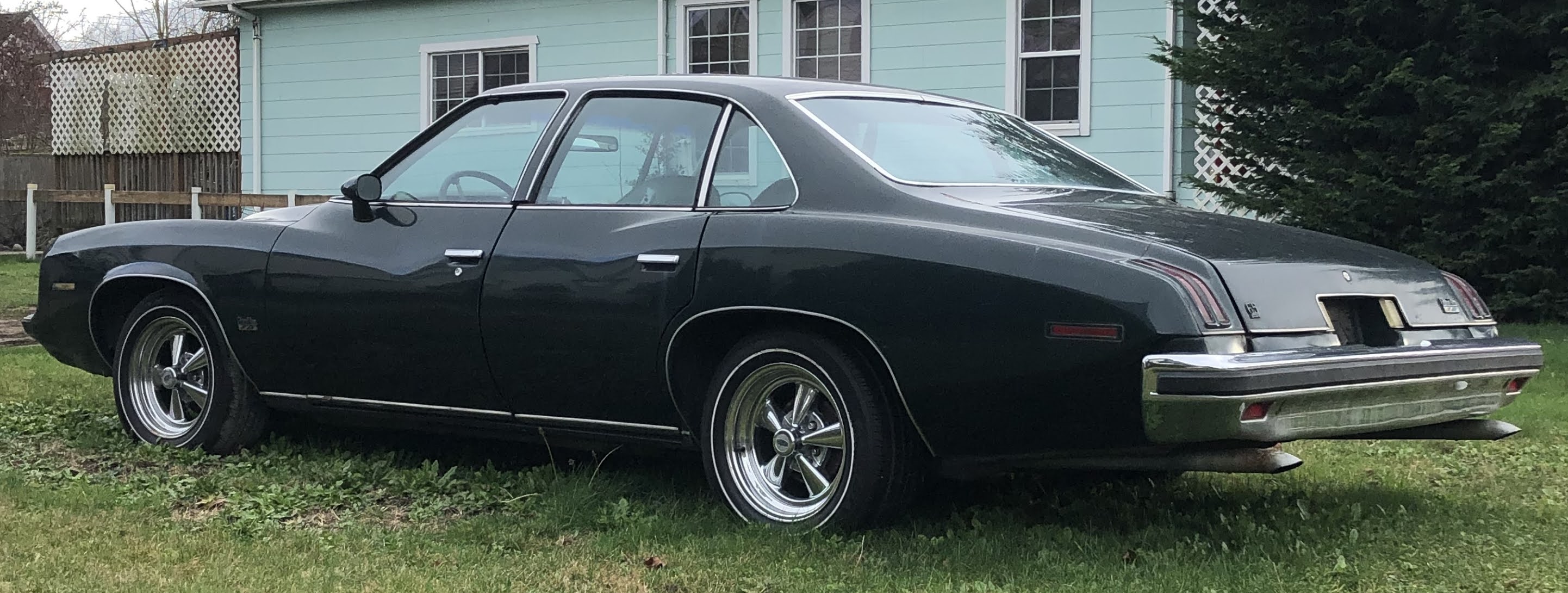
Oil Crisis? What Oil Crisis? 1973 Pontiac Grand Am

The GM A-body was America's standard car in the 1970s. GM sold about 600,000 vehicles per month in the US in 1973; about three times as many as they do now. The car pictured was America's best-selling car for years in the form of the Oldsmobile Cutlass.

The Grand Am was the top option package for the Pontiac LeMans series. It came standard with a gas-guzzling 400 c.i. V-8 and a premium interior. It was more expensive than that year's Pontiac GTO, another LeMans option package (and a shadow of the GTOs of the past). I've never seen a Grand Am four-door before; there were fewer than 9,000 made in 1973.


Tuesday, January 26, 2021

Why Aren't You Terrorizing a High School Somewhere? 1973 Plymouth Duster

Like the Chevy Nova from the same era, the Duster was a favorite for swapping in a big, smoky V8 and loudly announcing one's obnoxious presence to one's public school classmates.

Here's an unmodified Duster from the same year.


Monday, December 28, 2020

Land of the Giants: 1962 and 1973 Lincoln Continental in the Central District

There's plenty of parking in Seattle's Central District, and it's where I spot a lot of vintage Detroit iron. The older car pictured here appears to be a daily driver, but it looks like the later Lincoln hasn't moved in a year or three.


Thursday, April 9, 2020

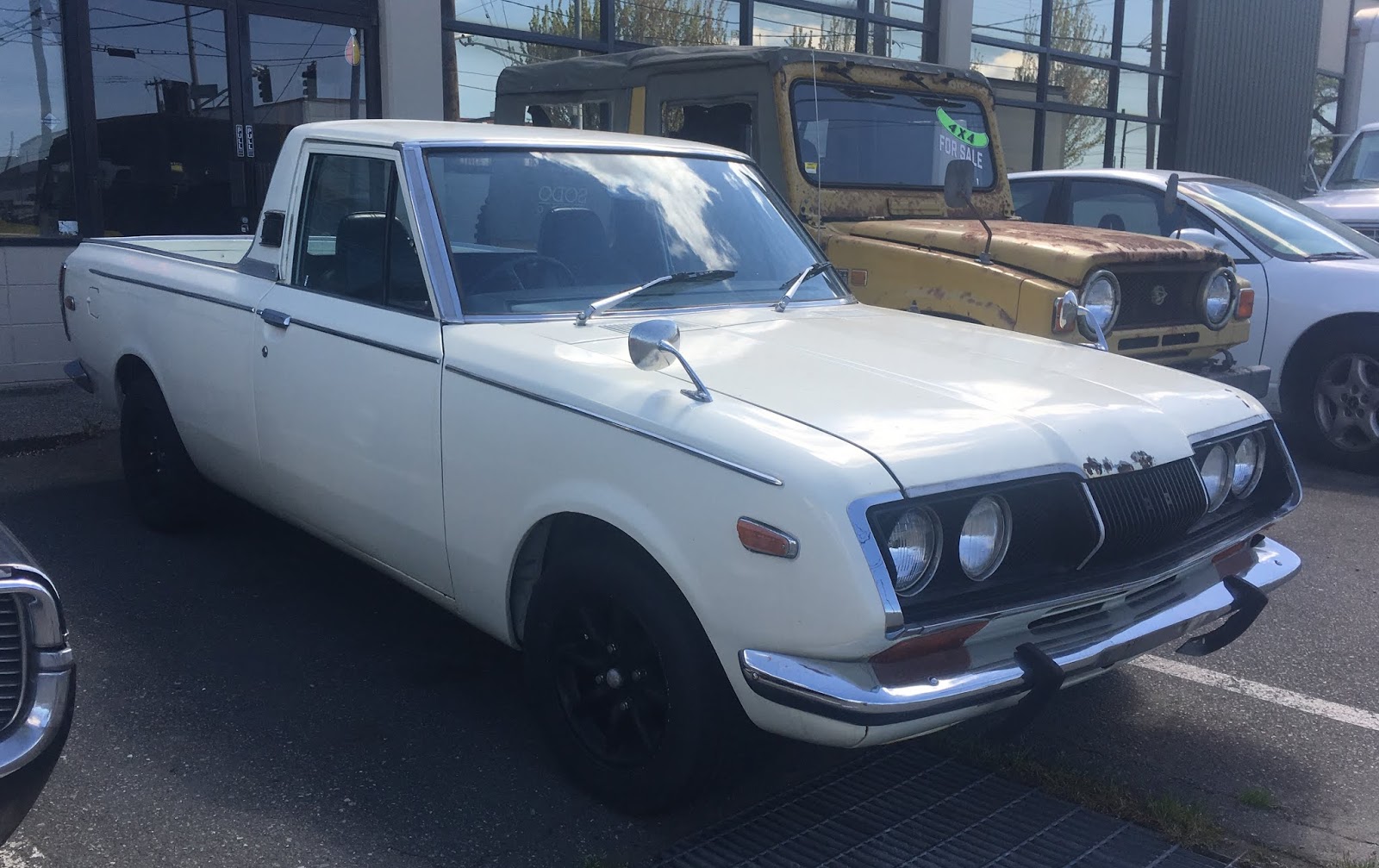
1973 Chevrolet Nova 350

Chevy Nova, terrorizing your local high school parking lot since 1962! This immaculate Nova is a throwback to the earlier era of muscle cars - Chevy's cheapest platform combined with a huge engine.


Saturday, January 25, 2020

1973 Dodge Charger

This mean machine deserves to be set free from the storage lot under Ballard bridge. It should be in a high school parking lot intimidating the kids with Toyotas. I like the after-market air scoop.


Monday, December 9, 2019

1973 Triumph Stag - "The Worst Engine Ever Made"

Here are two of the fewer than 3,000 Triumph Stags imported to the US. I've never seen one before, and with good reason: the Stag is considered by many to be the least reliable car of all time.


Triumph spent more than five years engineering the Stag's new V-8 engine before its introduction in 1970. Five years developing the worst engine ever made. From Wikipedia:

"The Stag rapidly acquired a reputation for mechanical unreliability, usually in the form of overheating. These problems arose from a variety of causes. 

First, the late changes to the engine gave rise to design features that were questionable from an engineering perspective. For example, the water pump was set higher on the engine than is usual. If the engine became hot in traffic, and coolant escaped from the cooling system via the expansion bottle, the reduced volume of fluid left when the engine cooled down again fell below the level of the pump, which would eventually fail as a result. Water pump failures sometimes occurred due to poorly-hardened drive gears, which wore out prematurely and stopped the water pump.

A second cause of engine trouble was the lack of attention to corrosion inhibitor in the coolant. The block was made from iron and the heads from aluminium, a combination that required the use of corrosion-inhibiting antifreeze all year round. This point was not widely appreciated by owners or by the dealer network supporting them. Consequently engines were affected by electrolytic corrosion and white alloy oxide sludge collected in radiator cores, reducing radiator efficiency and causing overheating. The result was head gasket failure due to cylinder head heat distortion, a very expensive repair. Owners would usually get their repaired cars back with the radiator still clogged, leading to repeat failures.

A third cause of trouble was the engine's use of long, simplex roller link chains, which would first stretch and then often fail inside fewer than 25,000 miles (40,200 km), resulting in expensive damage. Even before failing, a stretched timing chain would skip links and cause valves to lift and fall in the wrong sequence, so that valves hit pistons and damaged both. This fault may have been worsened by poor quality chains.
 
Another problem with the cylinder heads was said to be the arrangement of cylinder head fixing studs, half of which were vertical and the other half at an angle. Anecdotally, this arrangement was used to reduce production costs, as the cylinder head mounting studs and bolt were all accessible with the rocker covers fitted. This allowed the factory to assemble the cylinder head completely before fitting to the engine. The same arrangement worked well enough on the 4-cylinder engines, but in the V8 the angled and vertical studs, when heated and cooled, expanded and contracted in different directions sufficiently to give rise to sideways forces that caused warping of the engine block.

Finally, although pre-production engines cast by an outside foundry performed well, those fitted to production cars were made inhouse by a plant troubled with industrial unrest and inadequate quality control. Engines are still being discovered with casting sand inside, blocking the coolant passages and causing overheating."

Observations:
* The orange car was last registered in Washington in 1987. If someone managed to keep this car running more than 10 years, that person is a genius.
* The attempt at body work is adorable - sort of like buying a new tie for someone in an irreversible coma.
* These cars have removable hardtops.
* I do like the stag emblem on the grill.


Friday, October 11, 2019

1973 Ford Mustang

Seattle, Washington. The kind of city where you can spot three 1973 Mustangs in just a few minutes. Start from lower Queen Anne to see this one, then check out this Mach 1 in Magnolia, then head up to Greenlake to spot this very Mad Max '73.

This Mustang has the "Grande" package, which means a vinyl roof, deluxe interior and better sound insulation.


Wednesday, July 10, 2019

1973 AMC Javelin, Pierre Cardin edition

From Automobile Magazine: "The Cardin Javelin is arguably the most fully realized of all the designer-branded cars of its early era. The interior is truly a spectacle, with pleated upholstery stripes in plum, orange, white, and silver against a black background. The environment is flamboyantly psychedelic, although in a tailored way. In period print advertising for the car, Monsieur Cardin (AMC included a phonetic spelling of the name, Kar-dán) commented, "People should feel like they’re sitting in a living room instead of sitting in a machine." That is, of course, if your living room is done up in space-age style on par with a discotheque in Saint Tropez or perhaps a movie set from "Barbarella." The decor package was optional for all 1972 and ’73 Javelins for a mere $84.95 and included exterior badging."

This Javelin appears to have every factory option, including AMC's ferocious 401 c.i. V-8.


Wednesday, March 13, 2019

1973 Oldsmobile Delta 88 convertible

A dying breed: Chrysler built its last convertible in 1971; Ford in 1973. GM held on longer, building about 25,000 copies per year of the car pictured through 1975. It was sold as the Chevy Caprice, Olds 88, Pontiac Grand Ville and Buick Le Sabre. The Cadillac Eldorado convertible held on until '76.

Imported convertibles faded away too. MG and Triumph went of out business. Fiat gave up on the US. Regulation killed the VW Beetle convertible. The only imported convertibles to hang on in significant numbers were the VW Rabbit and Alfra Romeo Spider.

By the mid-80s, American convertibles were back in the form of the Chrysler LeBaron and Ford Mustang. Unfortunately, those cars were built as coupes and then sent to third-party builders who cut off the tops and transformed them into open-top models. In other words, they were pretty much junk despite costing about twice as much as their hardtop brothers.


Sunday, September 30, 2018

Suddenly, It's 1974!

Which is the best set of wheels to get you home in time to watch President Nixon resign? This 1973 Dodge Dart Swinger has the cool Rallye wheels, unusual on the inexpensive Dart. On the other hand, these Datsun B210 four doors with their 1.4 liter engines kept you from running out of gas during the recent oil crisis.

Note the last picture below appears to show a Scion all the way on the right. That's an illusion; it's 1974! Let's get Led Zeppelin tickets!